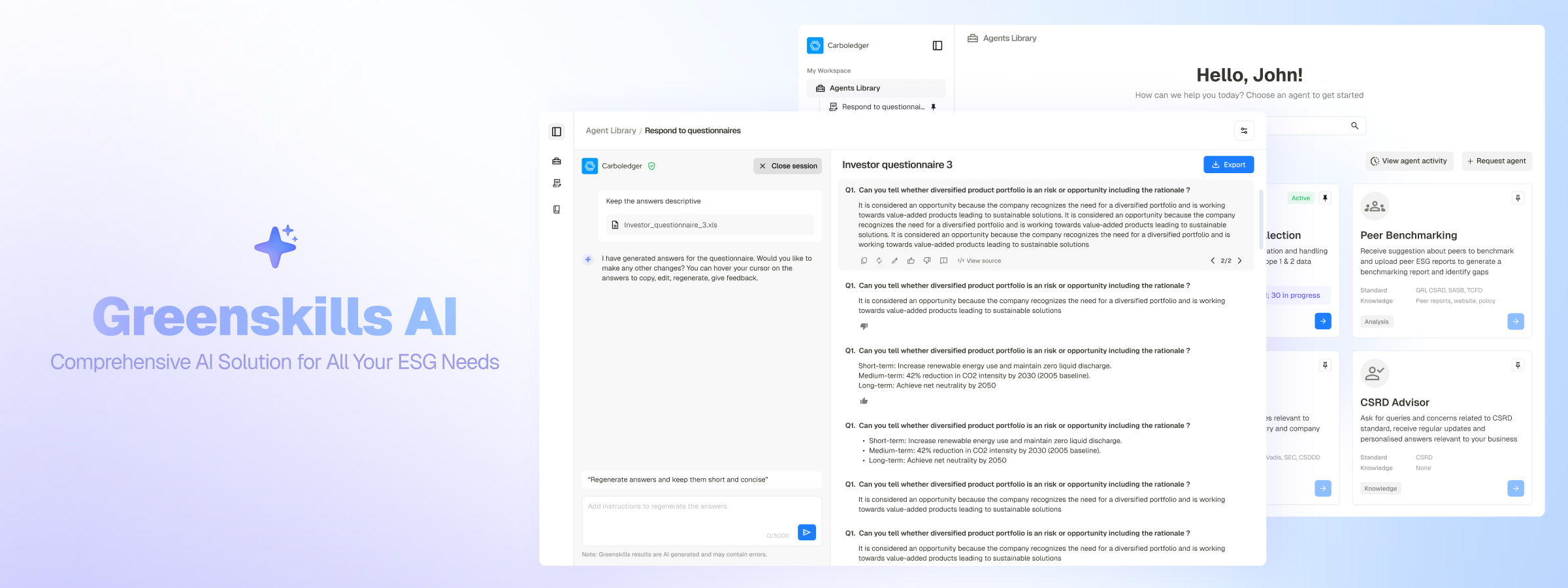
GreenSkills AI
Designed 5+ specialized AI agent suites for enterprise ESG reporting. Led domain research with industry experts, set UX guidelines, and built transparency-first patterns for AI-generated outputs.
ESG reporting was operationally expensive and fragmented
Large enterprises were spending weeks manually collecting ESG-related data across departments, validating information, responding to investor questionnaires, benchmarking against peers, and preparing compliance reports for frameworks such as CSRD, GRI, and TCFD.
Most workflows depended heavily on spreadsheets, sustainability reports, internal documents, policy files, and repeated coordination between compliance teams, executives, HR, sustainability departments, and consultants.
One of the largest operational bottlenecks was responding to ESG questionnaires from investors, customers, and stakeholders. Teams often spent days or weeks manually locating answers across reports and internal documentation before formatting them into submission-ready responses.
The opportunity was not simply automating report generation, but designing an AI-assisted system capable of orchestrating multiple specialised workflows while maintaining enterprise-grade trust, traceability, and confidentiality.
ESG knowledge was distributed across disconnected systems and teams
The challenge was not a lack of information. Organisations already had sustainability reports, emissions datasets, policy documents, compliance records, and operational data.
The problem was that this information was fragmented across departments, formats, and reporting frameworks.
Compliance teams had to:
- manually collect data across the organisation
- validate reporting consistency
- interpret ESG frameworks
- benchmark against peers
- answer investor questionnaires
- generate compliance-ready reports
This process created massive operational overhead and slowed down reporting workflows significantly.
At the same time, the system operated on highly confidential enterprise data, meaning automation could not come at the cost of trust, auditability, or organisational control.
Designing trust into multi-agent AI workflows
The hardest challenge was not generating AI outputs. It was helping enterprise users trust, verify, and control those outputs.
Each AI agent was designed around a highly specific operational context:
- Questionnaire response agent
- CSRD indexing agent
- Peer benchmarking agent
- ESG training agent
- Data collection agent
These agents could communicate with each other sequentially when required, but unrestricted autonomous communication created serious confidentiality and governance risks.
The system therefore needed to balance:
- automation with human oversight
- speed with accuracy
- AI assistance with auditability
- knowledge sharing with strict data boundaries
A major part of the UX challenge was making AI-generated outputs traceable and verifiable. Users needed visibility into:
- where information was extracted from
- which document it came from
- which section supported the answer
- how the final response was generated
Without this transparency, enterprise users were unwilling to trust AI-generated compliance outputs.
Specialised agent architecture instead of general-purpose AI
Instead of using a single generic AI workflow, the system was designed as a suite of specialised agents, each operating within a tightly scoped knowledge context.
This reduced hallucination risk, improved output consistency, and prevented operational workflows from becoming contextually noisy.
Human-in-the-loop approval workflows
Because the platform handled highly confidential enterprise information, fully autonomous agent behaviour was intentionally avoided.
When agents needed to communicate or access specialised organisational knowledge, human approval and oversight remained part of the workflow.
This ensured:
- sensitive information stayed within organisational boundaries
- users retained control over knowledge access
- AI outputs remained reviewable and accountable
Source traceability and explainability
Every generated response included traceable citations back to the original source material.
Users could inspect:
- source documents
- extracted sections
- referenced reports
- supporting evidence
This significantly improved trust during ESG reporting and questionnaire workflows.
AI-assisted questionnaire automation
One of the highest-impact workflows was investor and stakeholder questionnaire response automation.
Users could upload questionnaire spreadsheets directly into the platform, and the system generated draft responses using organisational sustainability reports, policy documents, and ESG datasets.
Instead of spending weeks manually locating answers, teams could review, verify, and export completed responses within minutes.
What changed
The platform significantly reduced manual ESG reporting overhead across compliance and sustainability workflows.
Key improvements included:
- Reduced questionnaire response time from weeks to minutes
- Reduced manual cross-department data collection effort
- Improved consistency across ESG reporting workflows
- Faster peer benchmarking and compliance readiness analysis
- Centralised ESG knowledge retrieval across organisational datasets
The explainability and source-traceability workflows also increased enterprise trust in AI-assisted reporting by allowing users to verify exactly how outputs were generated before submission.
Most importantly, the system demonstrated that enterprise AI workflows could automate operational complexity without removing human oversight from critical compliance processes.


