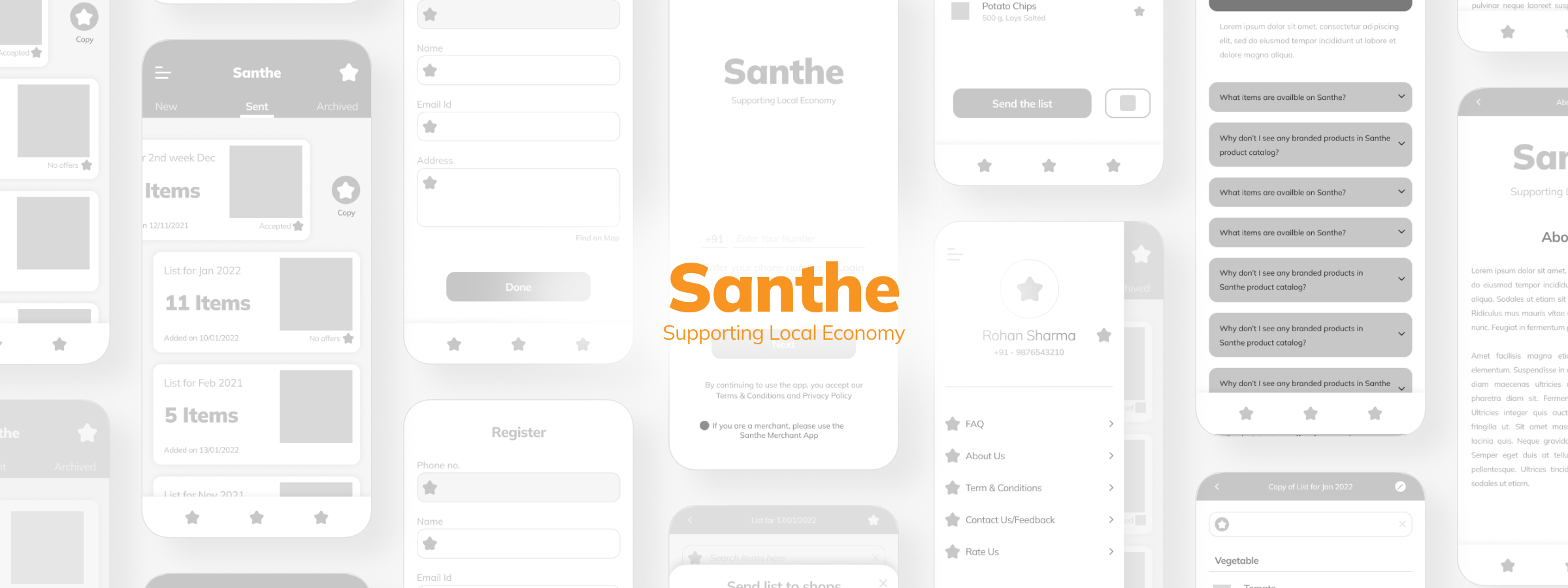
Santhe
Led end-to-end UX research and design for three stakeholder-facing apps covering the full order-to-delivery journey.
Local vendors were becoming digitally invisible
Santhe was designed to support local commerce by helping nearby consumers connect with neighborhood vendors through a structured digital platform.
In India, local Kirana stores and small retailers were increasingly losing market share to large eCommerce platforms, quick-commerce services, and organized retail chains. These larger platforms offered convenience, pricing transparency, delivery, and digital accessibility, while most local vendors still relied on traditional offline interactions.
At the same time, many consumers still preferred local vendors because of familiarity, flexibility, and pricing advantages. But the process remained fragmented, inconsistent, and time-consuming.
The opportunity was to create a platform that digitized local shopping workflows without removing the human and local nature of neighborhood commerce.
Local shopping lacked structure, transparency, and convenience
Traditional local shopping involved multiple friction points for both customers and vendors.
Consumers often had to:
- visit multiple stores physically
- negotiate prices manually
- repeat grocery lists every month
- deal with inconsistent product availability
- spend time comparing prices across vendors
Vendors struggled with:
- low digital visibility
- inability to compete with larger platforms
- fragmented customer communication
- lack of structured online ordering systems
Research also revealed an important trust issue. While users wanted to support local businesses, many still trusted larger brands more when it came to reliability, quality, and accountability.
The challenge was not simply building another grocery marketplace. The real challenge was reducing the operational friction of local shopping while maintaining the accessibility and familiarity of neighborhood vendors.
Designing simplicity for both customers and local vendors
One of the biggest design challenges was balancing simplicity with flexibility.
The platform needed to work for:
- customers with recurring grocery workflows
- vendors with limited digital maturity
- inconsistent local inventory systems
- users unfamiliar with structured digital ordering
Research showed that users did not want a complex shopping flow. They wanted a faster and more organized version of how local shopping already worked.
Another challenge was reducing communication overhead between customers and vendors. In traditional workflows, customers repeatedly explained product preferences, quantities, brands, and delivery requirements manually across calls or chats.
The system therefore needed to:
- simplify list creation
- reduce repetitive effort
- improve pricing transparency
- make vendor responses easier to compare
- reduce uncertainty during the buying process
Anonymous bidding-based vendor workflow
Instead of directly browsing individual stores, users could create grocery lists and send them to nearby vendors.
Vendors then responded with offers, allowing users to compare pricing and choose the most suitable option.
This approach reduced the need for manual bargaining while still maintaining competitive pricing dynamics between local businesses.
Reusable grocery list architecture
Research revealed that grocery shopping behaviour was highly repetitive month-to-month.
To reduce repeated effort, I designed a reusable list structure with:
- New
- Sent
- Archive
workflows
Users could duplicate archived grocery lists instead of rebuilding them every time, significantly reducing friction for recurring purchases.
Flexible product discovery and customisation
Local inventory varies significantly between vendors, so relying only on rigid product catalogs would have created usability issues.
The system therefore supported:
- search-based discovery
- suggested products
- custom product additions
- quantity and unit selection
- preferred brands/types
- notes for vendors
- custom item images
This balanced structured ordering with the flexibility required for local commerce.
Reducing trust and communication friction
Research showed that users were willing to support local vendors if the process felt reliable and convenient.
The platform therefore focused heavily on:
- transparent offer comparison
- simplified communication flows
- structured shopping requests
- reducing ambiguity during ordering
The goal was not to replace local shopping behaviour, but to reduce the friction traditionally associated with it.
What changed
Santhe transformed an unstructured offline shopping experience into a more organized and digitally accessible workflow for both consumers and local vendors.
The platform reduced friction across:
- grocery list creation
- vendor discovery
- price comparison
- repeated monthly shopping
- communication between buyers and vendors
The reusable list architecture simplified recurring purchasing behaviour, while the bidding-based system introduced greater transparency into local pricing and vendor responses.
The project also explored how digital tools could help smaller local businesses participate in changing consumer behaviour without requiring the operational complexity of large-scale eCommerce systems.
Most importantly, the platform demonstrated how local commerce experiences could become more efficient and structured while still preserving the accessibility and flexibility that users valued in neighborhood shopping.
What I would do differently
Looking back, I underestimated how operationally difficult digital adoption would be for local vendors. While the customer experience became significantly more structured and convenient, many vendors still struggled with maintaining consistent digital workflows and responding efficiently to requests. If I were redesigning the product today, I would focus more on simplifying the vendor-side operations, improving trust mechanisms for customers, and creating smarter vendor-matching systems to reduce unnecessary coordination overhead as the platform scaled.


